
Creating Music Opportunities For Neurodivergent Students
My name is Izzy, and I am a young adult working to create more music opportunities for neurodivergent individuals. I am autistic myself, and I have been taking music lessons for 11 years. Music has always been a safe place for me to process my emotions and make new friends. I was lucky enough to join music groups where I felt comfortable and had patient teachers. Unfortunately, not everyone has the same access to music opportunities that can support neurodivergent people. Because of overstimulation, fear of new people, and performance anxiety, many music groups are not an appealing option for neurodivergent people who would otherwise benefit from them. I began my research to help promote music groups created for neurodivergent people and show teachers how they can make their current classes more accessible. In this article, I will share some of the strategies that have made music spaces more welcoming and supportive for neurodivergent students.
I began by watching a regular music group with a couple of autistic students. I took note of which activities the students reacted positively and negatively to. Taking inspiration from the activities they reacted positively to, I planned the next lesson with the teacher and helped out. Furthering my research, I observed the sensory-friendly show, “Frolic.” After the show, I interviewed Claire Sabatine, one of the creators of the show. She took me through not only how they designed the show, but also how the actors would adapt in the moment. Using my experience and research, I set off to implement my ideas.
Why did I specifically look into music as a way to support neurodivergent people? The reason is that the benefits of music in general are especially beneficial to neurodivergent people. In my own experience, I have found music to be a wonderful method for emotional regulation and forging connections with other people. Research has also proven these benefits. Research has shown that executive functioning and verbal intelligence, common struggles for those in the neurodivergent community, both improve after musical training. By addressing these issues, many neurodivergent people can experience improvements in their daily life, thus highlighting the importance of music for this community in particular.
Another benefit of music is that it can aid in the development of an identity. Due to many neurodivergent people masking (acting “normal” around others) for a significant portion of their lives, many struggle with their identity. By pretending to be “normal,” many neurodivergent people may find it difficult to separate their true identity from their persona. Music offers a safe place to explore oneself, allowing people to develop their identity.
When done in groups, music can have important social benefits. When making music in a group, one must learn to pick up nonverbal cues and respect, cooperate with, and be empathetic towards others. All these skills are necessary in everyday life. However, social skills are a very common struggle for those in the neurodivergent community. Struggles with empathy and social cues often lead to loneliness and isolation. Nevertheless, music groups can create a safe space for individuals to explore connection with others. Music groups can be an excellent opportunity for many neurodivergent people, as they not only help forge connections with others but also help develop social skills that can be used in everyday life. Because of the benefits of executive functioning, verbal intelligence, developing identity, social skills, and connection, I chose music as a way to support my community.
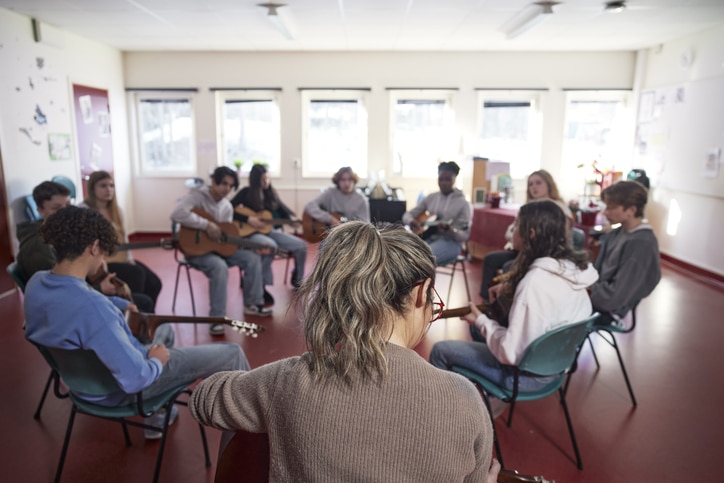
Taking everything I learned, I created my own music group specifically designed for neurodivergent children. There were many different things I included to specifically support our neurodivergent students, including a transition period at the beginning. Due to poor executive functioning, many of the students struggled with transitions. One way we alleviated this was creating an individual music exploration time at the beginning of every class. Small musical instruments were scattered throughout the classroom, allowing the students to roam freely, touch different things, and get into a musical mindset. Once it hit a set time, everyone would gather into a corner together. We specifically chose small circular mats to sit on rather than chairs, as it allowed the students to move more while still staying in the area. Another item we included in our corner was a schedule on the wall. The schedule had words and images for each activity we would do, and students were allowed to come up and move the star to the next activity. Additionally, we included a small sound bowl to not only have the students incorporate a sound with transition time, but also to allow more students to be involved. Having students be involved in the transition time, even with just using a sound bowl or moving a star, allowed a sense of control that they found comforting.
Having a schedule didn’t only help the students feel more comfortable, but also ensured we were taking care of the students’ needs. Included in the schedule that we found especially useful was stretch and movement. Stretch was one of the first activities we did in each class, which not only ensured the students had an opportunity to get up and move, but also gave students the ability to work on mindfulness. As for movement, we typically did it in the middle of the class. From my own observations, I noticed that neurodivergent students especially struggled when expected to stay still for extended periods of time. Some skills that we found we could easily incorporate into movement were rhythm, dynamics, tempo, and interpretation of songs. Another part of the schedule that we found more useful than expected was clean-up. Clean-up wasn’t only a time for students to understand that they were about to leave, but also a time for relaxed movement. Though we included it later, we found that it eased the transition out of class, which many parents appreciated.
Other things we included that helped support the students were that we had scattered around the room quiet objects that students were allowed to use or hold during class. These objects included fidgets, squishies, and any other props we were using for the class. We ensured all these objects wouldn’t distract other students, were quiet, and were okay if destroyed or stolen.
Another thing we found essential for the class was the number of adults in the room. Guardians were welcome to stay in the room or even participate if they wanted. If a student would rather sit with their guardian rather than in our corner, we never pressured them. All activities we did were never forced on to the students, which is why we required at least two instructors in each class. When a student would feel overwhelmed or didn’t want to do the activity, they had the option to do a quiet activity on their own or ask an instructor for a break. If a student needed a moment to step outside of the classroom because it became too loud, the other instructor in the room would always be there to help them. As stated before, nothing in the class was compulsory. The only expectation is that they would not disrupt other students. Though there were activities where we would go around the circle for everyone to have a turn, we always ensured the students knew they could say no. Some of the kids struggled with social anxiety, and though we always made sure they had the opportunity to push themselves, we never expected them to.
Another thing we did to help on that front was that we did not plan to have a recital for our group. Though many of the other groups would perform together, we chose not to. Our goal at the end of the day was to create a safe space for students to enjoy learning music. Though it was a music class, our priority was the students’ well-being, not their musical training. We tried to make this clear to guardians who enrolled their students in our class.
The environment is also a very important part of creating a comfortable space. When possible, avoiding the overhead lights and opting for natural light or other options were preferred. Additionally, noise levels needed to be controlled. In our case, we always kept the windows closed because of the outside noise and would close the door if it ever got noisy. Also, heat can lead to quicker overstimulation so we tried our best to keep the classroom at a comfortable temperature.
At the end of the day, consistency is what students responded best to. Though we had different activities, the schedule always remained the same. We stayed in the same room and met at the same time every month. By maintaining consistency, students always knew what to expect, which greatly decreased their anxiety before and during class. With all of this combined, we created a safe and comfortable space for our neurodivergent students to learn music.
Another part of my project was joining a class that was not otherwise designed for neurodivergent students. Though I did help out during class, my priority was to support the neurodivergent students. One of the ways I did this was creating a separate safe space. The space was quiet, had plenty of natural light, and I brought many “support objects.” Some of these objects were quiet musical instruments, including a musical frog instrument, a kalimba, and a percussive pan flute. These objects enabled music exploration while avoiding overstimulation or frustration. Also included were fidgets, squishies, and soft objects that students could use to calm down. Another method for calming I included was coloring books. Coloring promoted mindfulness and allowed students to return to a focused state. One object that I didn’t bring, but greatly appreciated, was a rocking chair. Any kind of seating that allows movement or stimming can be very beneficial for neurodivergent people. A rocking chair allowed students to unconsciously stim and thus calm down quicker. Having this quiet room also allowed the neurodivergent students to have a separate lunch space when we couldn’t eat outside. A separate lunch area not only prevented overstimulation from the cafeteria, but also gave the students downtime in the middle of the day. I made a point to tell the neurodivergent students that they could talk to me any time they wanted to go to the quiet area or take a break.
Another option for a break was going outside. Some neurodivergent kids can become extremely restless when sitting for too long, so if they wished, we could go outside, and we could walk or run a lap around the yard. As with my class, nothing was compulsory. If a student didn’t feel comfortable doing an activity, they were allowed to skip it as long as they didn’t distract the other students. On the final day, we had a recital, but we made sure the students knew they could back out at any time. Performing in front of a large crowd can be overwhelming, so the students knew they had a choice if they went up on stage or not. By having extra adults, a quiet area, comfort objects, breaks, and the ability to opt out of activities or performances, this otherwise “normal” camp became more neurodivergent friendly.
Nearly 1 in 5 people is neurodivergent. Difference isn’t a bad thing. Just as diversity is important for plants and animals, it’s important for humanity. History is full of neurodivergent people who made the world we live in today. Neurodivergence can give people unique outlooks and skills that can be greatly beneficial for society. By providing neurodivergent individuals with greater musical opportunities, we can make the world a bit more accepting, supportive, and welcoming.
Everyone deserves a chance. Will you give it to them?
Izzy M Stratman
2026
References
Miendlarzewska, E. A., & Trost, W. J. (2014). How musical training affects cognitive development: rhythm, reward and other modulating variables. Frontiers in Neuroscience, 7, 279. https://doi.org/10.3389/fnins.2013.00279
Moreno, S., Bialystok, E., Barac, R., Schellenberg, E. G., Cepeda, N. J., & Chau, T. (2011). Short-term music training enhances verbal intelligence and executive function. Psychological Science, 22(11), 1425–1433. https://doi.org/10.1177/0956797611416999
Rader, E. (2025, September 26). What is Neurodiversity? The Neurodiversity Alliance. https://thendalliance.org/what-is-neurodiversity/
The views expressed in this paper are those of the author(s) and do not necessarily represent the views of the NLM Family Foundation.